From the homophonic doppelganger of my own eponymous blog (sans the surname suffix "-e"), comes a report from Green Futures on the six possible forecasts for climate change that could come to fruition within this generation: "New Years Day 2030." These reports get a lot of coverage when they come out, because they give rise to snappy headlines like "Special report: How our economy is killing the Earth" (New Scientist). But how accurate are they, and are they useful?
This Green Futures report employs a very common technique that futurists use, known as "scenario building." Just like any good storyteller, a futurist knows that a narrative makes his point more evocative and memorable to the human ear, reared as it is on thousands of years of oral tradition. The potential scenarios are laid out for the audience, with one or more worst cases added (if we continue to disregard all that is holy, we're f*cked), one or more best cases added (if only you'd listen to me, things would be just peachy), and a "control" case (if everything continues as it has with no surprises, this should happen).

"Tell me, Spirit--how can I save money on my car insurance?"
The scenarios are not predictions, since that implies that the futurist knows with certainty what will happen (it definitely will rain tomorrow). They may or may not be forecasts, which like weather forecasts, are probability-based (there is a 60% chance of rain tomorrow).
The two most common applications of scenario-making are for climate change models and "peak oil" scenarios. The latter purports to determine when we will (or have) likely reached peak oil production, and when oil supplies will begin to dwindle. Such reports come annually from a variety of think-tanks, NGOs, governments, and oil companies themselves. There is even a (dubious-looking) Association for the Study of Peak Oil and Gas. The very practice of scenario-making was developed early on by Shell Oil, through the efforts of in-house futurists like Jeroen van der Veer, and are still produced every three years. The IEA produces several annual reports, such as the World Energy Outlook and Energy Technology Perspectives. The US Department of Energy produces its own annual Annual Energy Outlook. These reports have been quite variable in their accuracy over time.
The former, climate change, has fared no better. Global warming remains contentious in the public forum because climate change models have also proven to be fickle. The majority of mainstream scientists agree that climate change is a reality, and that it at least has some man-made causation. However, nailing how much and when is quite difficult. Extrapolating from current trends ("if we continue to pump this amount of CO2 into the air and the temperature rises this much per year, the earth will be X-percentage warmer in 25 years") is misleading. It disregards the fact that certain tipping points, once reached, could accelerate or decelerate trends, transforming geometric growth into exponential growth overnight.
Raising the temperature just a few degrees, for example, could melt enough polar ice to release a catastrophic amount of embedded methane from the ocean bed into the atmosphere, creating a catalytic negative feedback cycle of warming. This is known as the "Clathrate gun hypothesis," and as a theory is far from uncontroversial. Even so, it's just one example of the unforeseen variables that must be included into a model that seeks to project trends in something as complex as the global climate.
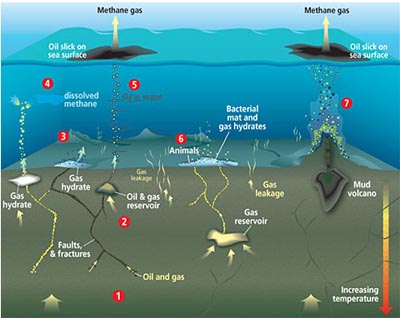
Here, we see a model for the cyclical movement of bullshit into the atmosphere.
For that matter, a current or future technical advance could just turn back the clock on climate change. Fusion nuclear power has been hanging on the edge of science for a half-century, promising endless wells of energy too cheap to meter, with no radioactive waste. Some ambitious folks in southern France think they might just be a decade away from this elusive wonder. But, we just don't know. Who predicted penicillin, the internet, or iPods? And just where are our damn rocket packs? Trying to factor disruptive technologies, paradigm-shifting scientific discoveries, or socio-political revolutions into future scenarios is fraught with error.

We've employed webcams for slightly different purposes than the Edwardians foresaw...
There is another, perhaps more important problem with scenario-making as a futurist methodology. Scenarios are narratives, and just like any story, they are the product of their author's biases and motives. It is no coincidence that energy scenarios from oil companies, governments, NGOs, and environmentalists carry wildly divergent conclusions. Depending on how optimistic or pessimistic the author is; what variables he chooses to include, emphasize, or deemphasize; or what givens are taken for granted (for example, there is a wide spectrum of opinion on how much oil is actually in the ground today), conclusions can be wildly different. There are the left-field theorists who question whether oil is really a limited resource after all. Each of these theories is inherently political, seeking as it does to affect public opinion, and by extension, public policy.
Scenario-makers, like science fiction authors or Utopians, seek to affect the behavior of their audience by piquing their imagination. One should be wary of the motives of both futurist Jerimiahs and Pollyannas. The only certainty about the future is that it's coming--anyone who tells you what will happen is either God or lying.